What to expect from leadership due diligence
As companies scale, a key question emerges: what do we need to evaluate in a leadership team pre-deal? Getting leadership due diligence right is critical for both investors and founders. In the high-stakes world of private equity and venture capital, the success of an investment hinges not just on the product and market, but on the people steering the company.
Investors can carry out due diligence as early as the pre-seed stage, but the process tends to be light and quick compared with increasingly more detailed analysis that takes place in later funding rounds.
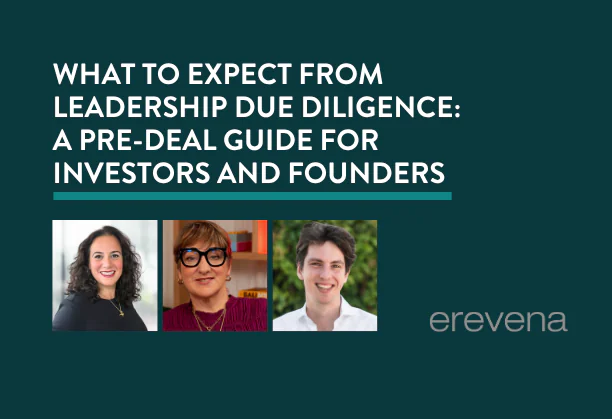
We’ll explore what investors look for in due diligence and how you can better prepare as a founder or investor, as you progress through funding rounds, with views from:
Louise Hill, Investor and Founder of GoHenry
Rezso Szabo, General Partner at Illuminate Financial
Maria Josife, FinTech Partner at Erevena
What do we need to evaluate in a leadership team pre-deal?
Beyond product quality and funding quantity, the most critical vector for company success is team quality and their capacity to execute against a vision and roadmap. Regardless of stage, it is crucial you gain a clear and objective view of the team’s capability, alignment, and readiness to deliver against the investment thesis. This means going beyond CVs and track records to understand how leaders operate together and how they share responsibility and make decisions. As well as evaluating whether their skills and experience match the challenges the business will face in its next phase of growth.
With that in mind, here are 5 core areas that investors will consider:
1. Leadership track record
2. Alignment with the investment thesis
3. Leadership capability and skills
4. Team dynamics and cohesion
5. Capability gaps in the team
What does leadership due diligence look like at each funding stage? A guide for founders.
The biggest issue and challenge during leadership due diligence is often “not planning the team and leadership build out early enough.” – Rezso Szabo General Partner at Illuminate Financial.
As startups move through funding rounds, investors gradually increase the depth of due diligence on leadership team. In the earliest stages, decisions are heavily based on the founding team and their potential. As the company grows however, diligence becomes more structured, data-driven, and risk-focused.
Pre-seed and Seed
At the pre-seed stage, with limited data on product performance and revenue, funding DD focuses heavily on founder credibility, expertise, and long-term potential. By the seed stage, a startup should have a prototype, early customers, or some product traction. This is when assessing whether founders can transition from idea-stage builders to company leaders, is a key priority.
Louise Hill, founder of GoHenry, recalls her own experience: “The differing approaches that can be taken when fundraising surprised me most. Some are due to the differing stages of investment, whilst others are due to the type of investor (i.e. friends and family, angels, HNWIs, VCs, Growth funds, etc).”
Louise added, “Friends and family rounds will already know the founders and are unlikely to question leadership skills much, whereas angels and HNWIs can often be more interested in the success of the business, the mission.”
Rezso adds his perspective for how this changes at Seed stage, “Even [as early as] Seed rounds, founders must demonstrate cohesion and the ability to attract high-calibre talent. As fundraising rounds grow larger, investors expect a strong core team in place much earlier.”
Common checks at this stage include:
Background and reputation
- Reviewing founders’ professional history
- Assessing domain expertise and technical capability
Leadership capability
- Ability to hire and manage early employees
- Early decision-making and strategic thinking
- Communication with investors and stakeholders
Team composition
- Whether the leadership team covers key functional areas (product, engineering, go-to-market)
- Identification of capability gaps that may need future hires
Founder dynamics
- Evaluating how co-founders work together
- Assessing complementary skills (technical vs. commercial)
- Understanding motivation and long-term commitment
Series A
“As soon as you reach a larger seed round or Series A,” added Louise, “There is much more attention paid to whether the leadership team in place is the right one for the next stage of growth”. Investors consider whether leaders in organisations can take the business to the next stage and beyond, whether a change will be disruptive, etc.
By the time a company raises Series A, it is expected to demonstrate measurable traction, such as consistent user growth or revenue. The focus is now on whether leadership can scale the organisation effectively. Due diligence becomes significantly more detailed here.
Some checks can include:
Structured reference checks
- Formal reference interviews with former colleagues, managers, and industry contacts
- Verification of leadership style and effectiveness
- Decision-making and strategy
- Assessment of how leadership has navigated early challenges
- Evaluation of long-term strategic vision
Hiring plans
- Critical hiring needs to achieve required growth metrics prior to series B.
At this stage, a key question arises: Can the founding team scale from a startup to a high-growth company?
When asked at what stage scrutiny meaningfully shifted and what triggered that change, Louise explained: “At GoHenry, it was really at Series A around six years in and a large round at $40m. Our founders and leadership team were assessed as to whether we had both the capability and the desire to take the business to the next stage.”
Series C+
By Series C and later stages, the company is typically scaling rapidly and may be preparing for a public offering or acquisition. Leadership due diligence becomes significantly more rigorous.
This is when it’s best to focus on whether the executive team can manage a large organisation, lead the company effectively, and deliver long-term growth. Particularly as the founder’s attention is pulled increasingly externally and towards future capital sources.
Key diligence areas include:
- Executive track record and bench
- Prior experience managing large teams or scaling businesses; previous success at this or later stage.
- Potential replacement of functional VPs in places of experienced Executives with experience at this scale and beyond.
- Proven operational leadership and governance capability
Board and governance structure
- Relationship between leadership and the board
- Decision-making frameworks and accountability structures
External reputation and risk
- Deep reference checks across the industry including former colleagues and employees.
- Background checks and reputation analysis
- Assessment of leadership stability and succession planning
While expectations evolve at each stage, the core principles remain consistent.
For founders: present a well-organised team with clear responsibilities, credible experience, and a strong awareness of its own gaps. For PE investors, the focus is on delivering growth with efficiency, while VC investors prioritise whether the leadership team can scale ahead of or in line with the company.
The evolving investor mindset: Influence of AI
As AI continues to shape modern industries, it has also begun to influence how leadership due diligence is conducted.
Rezso shared, “AI has created a once-in-a-lifetime opportunity, but also dramatically increased investor expectations. Capital is concentrating into a select few teams that appear to have near perfect founder (and leadership) market fit. It is a rational reaction: paying higher prices and investing larger amounts earlier than ever before has diminished investor risk tolerance for non-consensus bets.
To compete at this level, founders must demonstrate rapid team building momentum and a visibly well-rounded leadership team, often with already established credibility. It also means that fundraising is becoming harder for teams that don’t fit this narrow VC mould.”
AI is also challenging previous assumptions around leadership capability. As companies scale in more efficient, AI enabled ways, leadership capability and headcount are no longer synonymous. The need for Executives to deliver a coherent AI narrative, on how they will deliver outcomes through tooling and agents, not only people, is an important part of investor DD.
Checklist for fundraising:
“It’s easy as a founder to be so focused on access to the funding that the business needs, that you can forget to put yourself into the investor’s shoes and consider how they will assess the business,” says Louise, “It’s not just about growth and the prospects of an “exit”, it’s also about the leadership team and whether they can deliver the results.”
Do your homework
Before fundraising, founders should be honest about the strengths and gaps in the leadership team. If there are obvious hires needed, they should be upfront with them and show how new capital will strengthen the organisation. That can include discussing how their own careers will evolve as the business scales, and the functional roles they will occupy as the company gets bigger. Know who you need to hire, and what you will focus on.
Address gaps in your talent bench as part of your pitch
“It’s good practice to tackle these potential concerns head on in the pitch deck and in the conversations”, says Louise. “Demonstrate WHY you are the right leader. HOW you adapt to the changing stages of growth. HOW you lead the company through change. And lastly WHAT experience you have of doing that in previous roles.”
Avoid organisational debt as you scale.
“As the business scales”, comments Maria Josife, Partner at Erevena, “Founders should take care to avoid building organisational debt, as this is often quickly uncovered during due diligence. Operating models in SaaS, fintech and consumer businesses are well understood, and while enterprise AI is still evolving, clear patterns are starting to emerge. Don’t create roles that only work for one individual and would be impossible to refill if they left. Build the operating model first, then hire people to fit it – not the other way round.”
Acknowledge that your team will need to change as you scale.
“Most companies hit a point where great generalists need to give way to functional specialists”, adds Maria. “That may even mean members of the founding team stepping aside for experienced operators.” Be in front of that vs behind it.
Showing that level of self-awareness – and a willingness to evolve the organisation as the business scales – is a strong positive signal. Investors want to back teams who take advice and are proactive about building the capabilities needed to grow quickly.
If you’re a founder or investor looking to evaluate your executive team or enhance your board composition, get in touch with us here.
Share this article: