The role of the CEO is rapidly shifting. We’re seeing the focus evolve from operational oversight to driving large-scale transformation. As a result, organisations must rethink how they build leadership teams capable of navigating unprecedented market complexity.
In today’s fast-paced business landscape, hiring a C-suite executive is no longer business as usual. Success demands a keen strategic perspective, alignment with company culture, and leadership with a clear eye on the future.
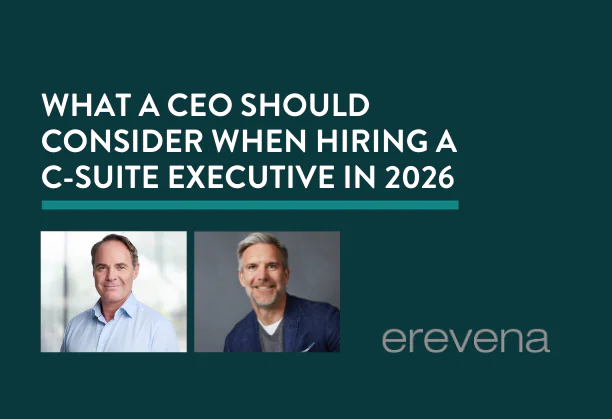
If you are a CEO/founder you are probably thinking: what should I consider when hiring a C-suite executive? In this article we’ll be uncovering some of the leadership hiring trends Erevena is seeing in 2026, alongside insights from an experienced CEO on the importance of the c-suite hiring process and how AI is reshaping the CEO mandate.
What key things should leaders focus on when hiring a C‑suite executive?
When hiring C‑suite executives, leaders should focus on several critical areas:
- Strategic fit: Can the candidate align closely with the organisation’s long‑term vision?
- Adaptability: Is the executive comfortable navigating uncertainty and complex change?
- AI and digital literacy: Do they understand how emerging technologies impact strategy?
- Cultural alignment: Will they champion the organisation’s values and foster trust?
- Execution capability: Can they drive measurable results while balancing stakeholder expectations?
C-suite hiring today falls into two distinct camps. On one side, AI-native and high-growth companies are expanding at unprecedented speed in 2026, redefining conventional strategies. In these organisations, CEOs and leaders need executives who can shape the companies of tomorrow, embrace AI-first thinking, and guide teams through entirely new challenges. Modern C-suite recruitment prioritises innovation, adaptability, and the creation of capabilities that didn’t exist before.
At the other end of the spectrum, many traditional B2B SaaS companies or capital-constrained businesses face pressure to pivot to profitable growth. Some leadership hiring trends in these companies are prioritising for resilience, operational discipline, and transformation capabilities, often needing leaders who can make tough trade-offs, capital, and sustain growth in a tighter market.
The latter has also impacted the balance between retaining the right C-suite talent for this new paradigm and knowing when new capabilities are needed at the top.
Talent may be more available than at the peak of 2021, but one question remains. Do candidates have the skills and experience required to succeed in a world where profitability takes precedence over growth and valuations are under pressure?
Hearing from a former CEO – Success starts from the top
Kyle Ferguson, former CEO at Forsta and Fraedom, says that identifying skill gaps in your C-suite is crucial. “Leaders can identify skill gaps by observing performance in leaner, more specialised teams and how they adapt to change and new technologies. Misalignment across functions (e.g. product, engineering and go-to-market) can also indicate deeper capability gaps.”
He states, “It’s about pattern recognition. I have learned not to over-engineer things and to measure what matters most. Something as simple as getting an organisation’s feedback across all levels can paint the narrative of where gaps and weaknesses lie.”
Reflecting on his tenure, the former CEO emphasised the importance of acting swiftly on identified challenges to ease organisational pressure. In 2025, his former company experienced a significant performance turnaround after implementing fundamental people and structural changes following the acquisition. The results were striking: a record-breaking 40% increase in net bookings. This transformation clearly demonstrated that hiring a strong C-suite executive team can unlock substantial, company-wide growth.
Leadership hiring trends and the impact of AI
AI is transforming leadership across strategy, decision-making, and organisational design. As a result, we are seeing teams becoming more talent-dense, with higher expectations and an accelerated pace. This is placing greater pressure on leaders to think strategically and prioritise quickly.
Leaders should be asking whether their C-suite understands the strategic implications of AI, and whether they are equipped to lead through them.
Even former CEO, Kyle Ferguson, suggests that an AI-focused leader should be able to “see the wood from the trees.” He explains that they should be able to understand connected data systems, rather than isolated data points – a key unlock in order to drive organisational efficiencies and speed to insights.
“We’re about to go through a period of change unseen in our history, and leaders who can embrace an AI-augmented world will be critical.” The most important quality of an AI leader in 2026 is the ability to adapt to change, interpret complexity and make clear strategic calls.
AI is allowing companies to uncover insights quickly and more effectively than before. This includes crucial data which can be utilised for customer experience and enhancing services. Hiring a C-suite executive team that can understand this transformation and act on it is crucial.
Talent gaps and recruitment challenges
AI is reshaping the C-suite in real time. Capability gaps are emerging faster, and new roles and functions are taking shape as organisations experiment and adapt. For CEOs, this makes hiring more complex. Looking in the rear-view mirror at what worked before may no longer be relevant.
Maintaining a strategic context on the dynamics of organisational design will be increasingly important. The most successful AI companies are growing with exponentially smaller teams than their SaaS predecessors.
AI is already making the leadership hiring processes more efficient, including using AI for research and note takers to support documentation. However this should not be confused with easy. The quality in hiring needs to improve and more time and effort should be spent on qualifying candidates for where the future of the business is.
Investor and stakeholder expectations for CEOs and leadership teams
Investors now expect scale-up leadership teams to demonstrate AI readiness. CEOs are under pressure to show they can harness AI for growth, efficiency, and competitive advantage without losing human judgment.
Over the past three years, funding for traditional B2B SaaS companies tightened, and a as a consequence, many businesses were forced to prioritise profitability – often reducing the growth rates and investment in go-to-market functions and restructuring their organisations to extend runway.
At the same time, intensified competition from AI-native companies has reshaped markets. Some scale-ups have found their product-market fit challenged, and in certain cases, effectively moved “back a stage” – from a Series B growth trajectory to operating more like a Series A business again.
This shift has had a significant impact on leadership dynamics. CEOs have needed to become far more hands-on, operational, and commercially involved. Meanwhile, C-suite hires who were well suited to a later-stage, scale-focused environment (for example, a Series C trajectory) may no longer align with what the business now requires.
In today’s climate, leadership fit isn’t just about calibre – it’s about stage, context, and adaptability
With every function needed to be performing at max level, the CEOs role of optimising with what talent they have becomes incredibly challenging.
Former CEO Kyle Ferguson’s take on this is that “Investors expect CEOs to execute, which is considered table stakes. Strong leaders are defined by their ability to embrace change, communicate clearly, scale business and platforms efficiently, and develop talent. This is especially the case in private equity-backed organisations, where driving efficient growth with fewer resources is non-negotiable.”
Performance and burnout risks
With mounting pressure from investors, it’s crucial to consider the toll this is taking. The CEO role has long been described as a lonely one, and a 2024 study found that 55% of CEOs have experienced mental health challenges, including extreme stress. Positioned between the board and the management team, CEOs often carry the weight of competing expectations. That pressure can have a profound personal and professional impact.
In fact, approximately 90% of CEOs in Tech have never been in the role before. This makes it a constant battle to learn on the job, without losing track of ambitions.
The shifting mentality on hiring a C-suite executive
Given the heated battle for talent before 2021, organisations must now focus on unlocking the team’s collective potential to succeed. For CEOs, this means identifying the skill spikes required in each function. As well as this, it’s understanding not only what each C-suite leader excels at, but also what they should not do. Achieving that balance, is no small feat.
Leadership performance naturally moves in cycles and understanding where C-suite executives are in their peaks and troughs is rarely straightforward. Are they entering a new growth cycle, or at the height of their performance? Has the uncertainty of the market thrown out the predictable nature of their cycles? This leadership confusion can at best lead to burn out.
So, what can CEOs expect from the new year? What are the leadership hiring trends we are seeing
With over 20 years in executive search, Erevena has seen what changes, what repeats, and what truly defines leadership success. Last year, we saw hiring accelerate in Q4, a trend that has continued into Q1. The shift from retaining sub-optimal talent to appointing new leadership can happen quickly. CEOs who delay those decisions risk being left with misaligned capability at the top.
We are seeing more executives choosing to stay in their roles. This is not always driven by loyalty, but by a perceived upside, attachment to equity that may have lost value, or hesitation about the risks of starting somewhere new.
Many leaders struggle to recognise when their cycle with an employer is coming to a natural close. As a result, moves are often delayed, or made for the wrong reasons rather than as part of a considered long-term strategy.
This applies to CEOs as well and even founders/co-founders.
How CEOs are dealing with funding pressures
The past 3 years has for most scale ups been the toughest fundraising climate seen since 2001. Whilst some of the hottest companies have received unprecedented amounts of capital at wild valuations, the polarised market has made some companies that could’ve have succeeded with more capital suffocating and struggling to achieve profitable growth, whilst others who long should have died and turned into fodder for other scale ups, receive undeserved life support from their investors.
Leading the distressed companies is never easy but we’re starting to see investors looking for diamonds in the rough and speculate on those with huge potential with niche areas of quality data. For CEOs, knowing when and how to put the throttle down and gear up for growth will be the real test in 2026.
Final takeaways: What will CEOs need to be prepared for?
This will be the year where increased use of AI will decrease team sizes, and lead to extreme execution followed by unparalleled output. For CEOs it will be key to understand the cause and implication on the org, talent and culture, and how to lead in this new paradigm.
Kyle Ferguson, former CEO, adds a reflective point: “The expectation of a CEO is that they come up with the big ideas and can execute flawlessly. The “How” is what sets good leaders apart. Again, it’s the ability to adapt to change, communicating strategy clearly to rise to this challenge.”
In summary, what CEOs should expect with c-suite hiring and structuring in the new year:
- Shrinking of team sizes with higher talent density means a tight and impactful C-suite
- Knowing what talent to keep and what to let go. The answer may surprise many
- Higher pace leading to extreme execution and massive increased output
- Focus on aligning parallel strategy and connected processes at pace without losing sight of bold ambitions
- A non-negotiable capability is understanding AI’s impact and knowing how to act on it
If you’re planning for the year ahead and need support with board structuring or leadership hiring, feel free to connect here.
Share this article: